Statistics show that 80 percent of all cat bites get infected. The most
frequent type of bite is a puncture wound. With their rather long
pointed teeth, a cat bite is frequently a puncture that doesn't bleed
very much, or at all. If the bite is in a joint, such as a finger
knuckle, your injury can prove to be even more serious with the
possibility of inflammation and bone infection.
The basic rule is to cleanse the wound
immediately. You can do this with any soap and hot water. An
anti-bacterial soap is even better. Then, sterilize it with
Betadine solution. This is surgical soap that kills just about
everything. It's for external use only, and keep it away from your
eyes. You can get it at any drug store in a liquid. For easy travel, it
also comes in an ointment. When you get home, soak the wound in
Epsom salts or peroxide and warm water. The idea is to get it as
clean as possible. This will reduce the possibility of infection and
inflammation.
If you do rescue work or are around cats of
"questionable" behavior frequently, it might be a good idea to carry an
emergency bite treatment pack. Many cat show judges do just that. They
keep a good triple antibiotic ointment and some form of antibiotic oral
drugs on hand. Zithromax and Augmentin are the most common drugs of
choice, according to Norm Auspitz, a CFA Allbreed judge. Since
there's plenty of liquid disinfectant at cat shows, getting a wound
clean at a show is not a problem.
It has also been suggested that having a
cat carrier nearby may save your body parts from a cat bite. If you
need to capture a cat, try having an open carrier in a place where the
cat can just run into it.
It's highly recommended that you seek
professional medical treatment for any cat bite. The bite can turn into
a nasty, infected mess in less than 12 hours. Treatment includes an IV
antibiotic and oral antibiotics. The most commonly used oral
antibiotic is Augmentin, which is an amoxocillin and clavulanate
mixture. Most cat bites contain Pasterella multocida bacteria,
with some Staph thrown in, and these drugs best treat those bacteria.
Cat Years Conversion
Converting between cat years and human years isn't as simple as
using a factor of 7 (as some people erroneously think with dogs, and
sometimes cats). The main reason is that cats mature quickly in the
first couple of years of life. To convert cat age to an equivalent
human age, an accepted method is to add 15 years for the first year of
life. Then add 10 years for the second year of life. After that, add 4
years for every cat year. This means that by year two, a cat has
matured to about the same as a 25 year old human.
So it isn't terribly complex, but you would have to do some
figuring on paper or in your head. That's where this cat years
calculator comes in handy.
For comparison and reference, the Cat Bible, a book by
Tracie Hotchner, provides the following list:
1-month-old kitten = 6-month-old human baby
3-month-old kitten = 4-year-old child
6-month-old kitten = 10 human years old
8-month-old kitten = 15-year-old human
A 1-year-old cat has reached adulthood, the equivalent of 18
human years
 Casa
de Gatos
Casa
de Gatos
 TIGGER
 adopted summer 1993 (JC
Shelter)
adopted summer 1993 (JC
Shelter)

 CASPER
  adopted summer
1993 (JC Shelter)
adopted summer
1993 (JC Shelter)
 SAMANTHA
 adopted summer 1994 (JC Shelter)




 Charlie 'WILDFIRE'
  adopted fall 1994
(Wildsong Bengals)
adopted fall 1994
(Wildsong Bengals)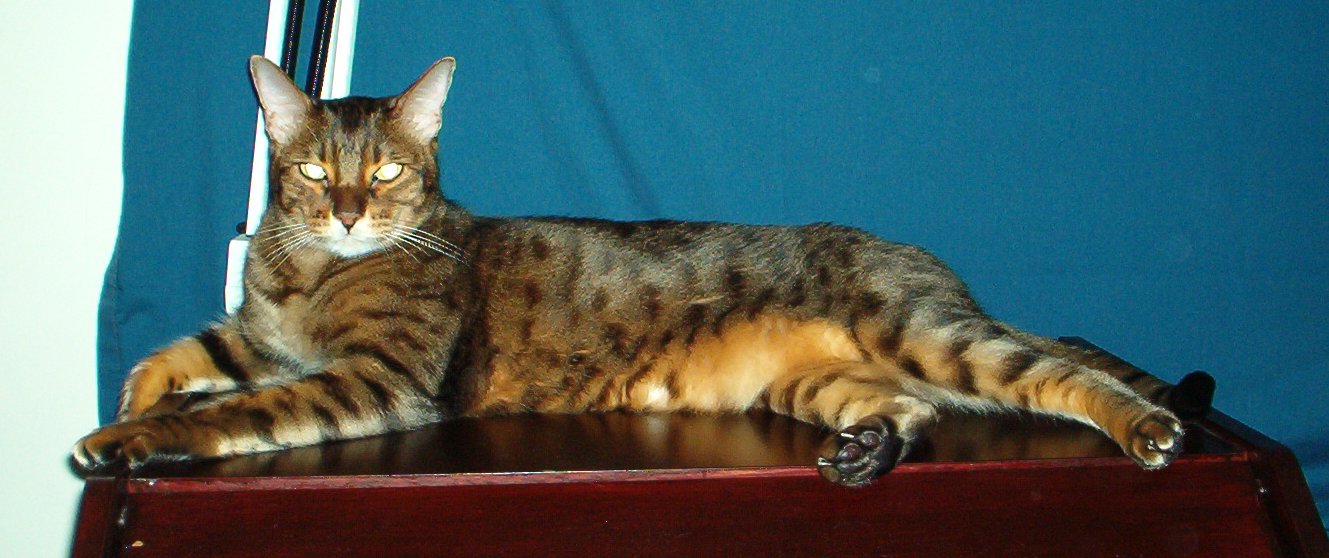



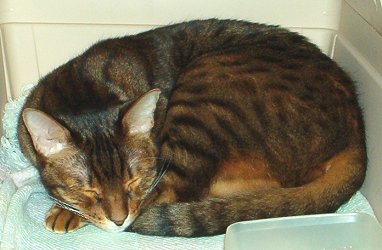

 PAWS
PAWS  adopted in 2000 (JC Shelter)
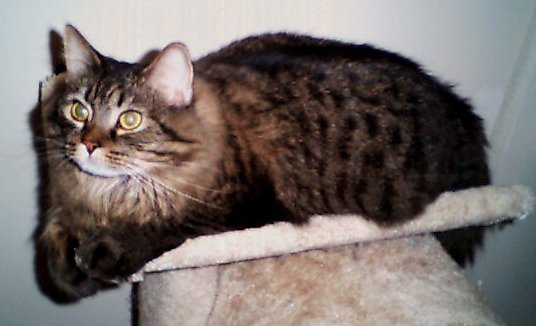


 FANCY
FANCY 
 adopted summer 2003 (JC Shelter)


 MINKIE
  adopted 10-2003 (homeless)

 BUDDY
BUDDY  adopted in 2004 (homeless)